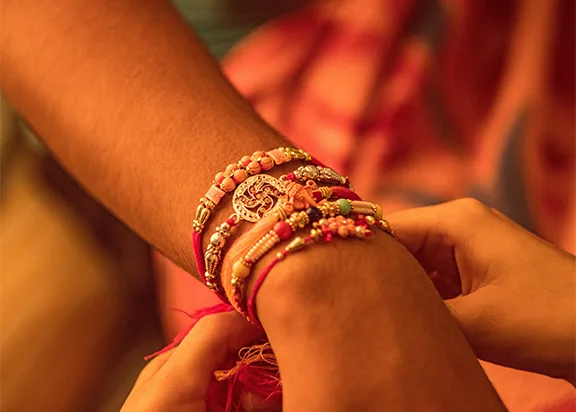
The bond between siblings is quietly extraordinary. Every part of the world nurtures it in its own way, but the Hindu calendar sets aside a whole day for it — Raksha Bandhan, literally the one who protects. And who is a better protector than a sibling when you need one? This guide covers the Raksha Bandhan 2026 date, the auspicious timing, the mythology the thread carries, and how families mark the day.
Meaning and Purpose of Raksha Bandhan
Raksha Bandhan comes from two Sanskrit words: raksha, meaning protection, and bandhan, meaning to tie. Together they mean knotting protection for someone’s well-being through a holy thread. The thread itself is usually cotton, sometimes a bracelet woven from flowers or set with talismans.
The origin has a twist that surprises most people: it had nothing to do with brothers and sisters. The oldest accounts describe it as a pre-war ritual performed by wives for their husbands’ safety. The sibling bond came later — and has since become the whole of it.
Who Can Celebrate Raksha Bandhan?
Because the meaning is protection rather than kinship, there is no rule confining Rakhi to a brother and a sister. It is tied between siblings, cousins, nephews and nieces, brother- and sister-like figures, and anyone whose place in your life is worth marking. The celebration reaches well past blood relations.
So can a husband and wife tie rakhi to each other? Ideally not. Whatever its origins, the meaning of the day has settled over centuries into affection between siblings and those who stand in a sibling’s place — and that is the sentiment it now carries.
Raksha Bandhan 2026 Date and Muhurat
Rakhi always falls on Shravana Purnima, the full moon of the Sawan month, which lands in August. The Raksha Bandhan 2026 date and its shubh muhurat are below.
Raksha Bandhan 2026
| Date | 28 August 2026 |
| Purnima begins | 27 Aug, 9:08 AM |
| Purnima ends | 28 Aug, 9:48 AM |
| Shubh muhurat | 5:57 – 9:48 AM |
| Duration | 3 hrs 51 mins |
| Bhadra kaal | Before sunrise |
In full: the Purnima tithi rises at 9:08 AM on 27 August 2026 and ends at 9:48 AM on 28 August 2026. The shubh muhurat for tying rakhi therefore runs from 5:57 AM to 9:48 AM on 28 August — a window of 3 hours and 51 minutes. Bhadra kaal, the inauspicious period that so often eats into the Rakhi morning, ends before sunrise this year, so it leaves the muhurat clear.
A note on time zones
These timings apply across the Eastern Hemisphere — India, the UAE, the UK and elsewhere. In the USA and Canada the tithi falls differently, and the ritual is usually performed on 27 August instead.
Every festival date, in one place
Purnima, ekadashi, vrat days and shubh muhurats for the whole year are laid out in the MyTemple Hindu Calendar.
Mythological and Historical Significance of Raksha Bandhan
The significance of Raksha Bandhan is carried by a handful of stories, each explaining the thread a little differently. The best known are these.
Indra Dev and Sachi
In the Bhavishya Purana, Indra and Sachi are husband and wife. During a fierce battle between the gods and the demons over Amaravati — heaven itself — Indra fought on the front line and met hard resistance from the demon king Bali. Sensing how the war was turning, Sachi went to Lord Vishnu for her husband’s safety. Vishnu gave her a holy cotton bracelet. She tied it to Indra’s wrist, and he reclaimed Amaravati.
This is the account that places the festival’s beginning with wives, not sisters — a thread tied before a husband left for war.
King Bali and Goddess Lakshmi
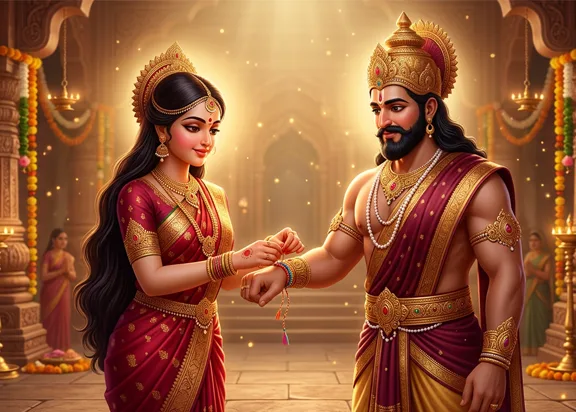
Told in the Bhagavata Purana and the Vishnu Purana. When Lord Vishnu won the three worlds — swarga, martya and patal — from the demon king Bali, Bali asked him to stay on in his palace, and Vishnu agreed. To bring him home to Vaikuntha, Goddess Lakshmi tied a rakhi on Bali’s wrist, called him brother, and asked as her gift that he release her husband.
Yama and Yamuna
Yama, the god of death, and Yamuna were brother and sister. For reasons of his own Yama did not visit her for twelve years, and she grew sadder as they passed. On Ganga’s advice he finally went to her. Yamuna was overjoyed, and asked to see her brother often; he blessed her with immortality. That meeting grew into another Hindu festival — Bhai Dooj.
Draupadi and Krishna
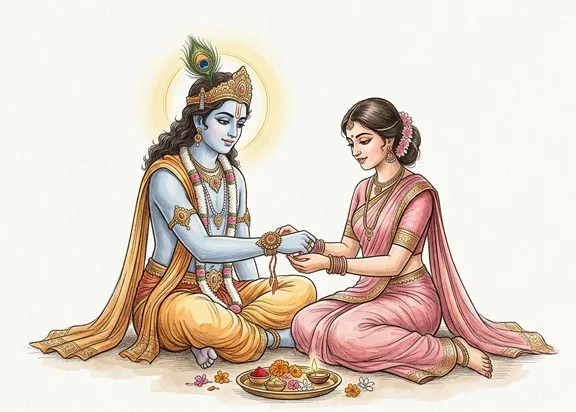
In the Mahabharata, Draupadi tore a strip from her sari and tied it on Krishna’s wrist. Krishna later did the same for Abhimanyu before he left for the great war at Kurukshetra.
The Freedom Movement, 1905
During the Partition of Bengal in 1905, Rabindranath Tagore asked people to tie rakhis on one another to strengthen Hindu-Muslim harmony against a British administration that was using communal division as a tool across the Bengal Presidency and the undivided Punjab. For a while, the thread was a political act.
What Should a Raksha Bandhan Thali Contain?
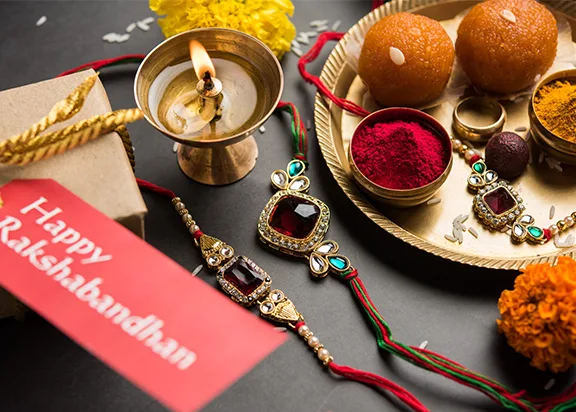
A Raksha Bandhan thali is simple, and every item on it does one job.
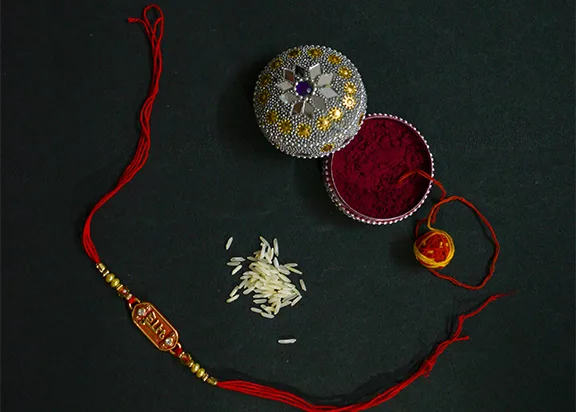
- Rakhi — cotton or flower-woven, though bejewelled designs are widely available now
- Unbroken rice, turmeric and durba grass, for a healthy and prosperous life
- Kumkum or sindoor for the tilak
- Diya, flowers and incense for the aarti
Aarti is regional
The aarti is a state-by-state and family-by-family tradition rather than a universal one. Not every household performs it. The rakhi, however, is tied everywhere.
Put your Rakhi thali together
Delivered across the UAE from MyTemple — sourced in India, and exactly what it promises to be.
- Premium Puja Thali — brass and silver-finish thalis for the ceremony
- Prayer Essentials — kumkum, roli, akshat, incense
- Diyas — brass and clay diyas for the aarti
- Idols & Statues — a home-mandir idol makes a lasting Rakhi gift
How is Raksha Bandhan Celebrated? A Step-by-Step Guide
Raksha Bandhan is observed during the shubh muhurat and closes with a blessing and, in many homes, an aarti. India being what it is, the ritual varies by state — it is most elaborate in the North and West. Broadly, the day runs like this.
- The rakhi ritual. Sisters perform the rakhi ritual for their brothers, following whatever their family tradition is. Brothers can do the same in return — there is no rule making this a one-way ceremony, or a female one.
- Prayer and sweets. Both pray for the other. Wishes are exchanged, and so is the mouth-sweetening that follows almost every good moment in an Indian household.
- Gifts. Surprise each other. A festive gift chosen with some thought carries further than the thread does.
- The meal. Eat together, with everyone. Raksha Bandhan is a family occasion more than a private one between two people.
Rakhi gifts, delivered across the UAE
Idols, décor, festive hampers and gift-ready pieces — the MyTemple Festive Gifting collection is built for occasions exactly like this one.
Happy Raksha Bandhan Wishes for Brothers and Sisters
What survives a festival is rarely the ritual — it is what was said while it happened. So make this Raksha Bandhan count with something that sounds like you rather than like a greeting card.
Raksha Bandhan Wishes for Brother
- Encouragement: Happy Rakhi, my mentor — thank you for being a pillar of my life.
- Teasing: I promise I will keep teasing you for the next 364 days. Love you!
- For a younger brother: Happy Rakhi, my sweet hero. Grow taller and keep shining every single day.
- Attachment: Whatever comes in the future, I will always be there by your side.
- Fun: Our sibling fights deserve an award. Happy Raksha Bandhan.
Raksha Bandhan Wishes for Sister
- Emotional: Choti, after Mummy you are the only one with the right to spoil me with everything.
- For an elder sister: Thank you for being my Mummy 2.0. I cannot imagine a day without you.
- Teasing: Trust me — your hair and Mummy’s broom are the same thing. So here is your favourite hair serum, before the day-long complaining starts.
- Fun and teasing: No matter how we fight the rest of the year, today we are one soul, one life. Happy Rakhi!
- Attachment: Sweetheart, I promise to make this world as beautiful and as cheerful as your soul.
Final Takeaway
Raksha Bandhan is not limited to blood relationships, or even to family tradition. It belongs to the people in your life you care for and who care for you — and they can belong to any faith. Rather than confining a warm ceremony to ritual technicalities, extend it to the people who have earned it, and celebrate properly. Happy Raksha Bandhan.
Need a Pandit Ji for the ceremony?
MyTemple connects families across the UAE with experienced Pandit Ji trained in Haridwar, Kashi and Vrindavan, for pujas, path and every festival ceremony at home.
FAQs
When is Raksha Bandhan 2026 being celebrated in India and globally?
Raksha Bandhan 2026 falls on 28 August 2026 in India and across the Eastern Hemisphere, including the UAE. In the Western Hemisphere — the USA and Canada — it is generally observed on 27 August, because the Purnima tithi falls differently in those time zones.
What is the shubh muhurat for tying rakhi?
The shubh muhurat for tying rakhi runs from 5:57 AM to 9:48 AM on 28 August 2026 — a window of 3 hours and 51 minutes, ending when the Purnima tithi does.
What does a rakhi symbolise?
A rakhi symbolises protection against harm, a healthy life and prosperity — a promise of care rather than an ornament.
What should I keep in the puja thali for Rakhi?
A Rakhi thali holds the rakhi itself, unbroken rice, kumkum or sindoor for the tilak, turmeric, flowers, a diya and an incense stick. Sweets are added for the mouth-sweetening that follows.
Is Raksha Bandhan only for brothers and sisters?
Not at all. A rakhi can be tied between siblings, cousins, a sister-in-law or brother-in-law, a nephew or niece, and any brother- or sister-like figure in your life. The meaning is protection, not kinship.
What is bhadra kaal?
Bhadra kaal is a period considered inauspicious in Hindu astrology — unsuitable for starting anything new or performing a religious ceremony. In 2026 it ends before sunrise on 28 August, so it does not interfere with the rakhi muhurat.